SCOPE OF THE REPORT
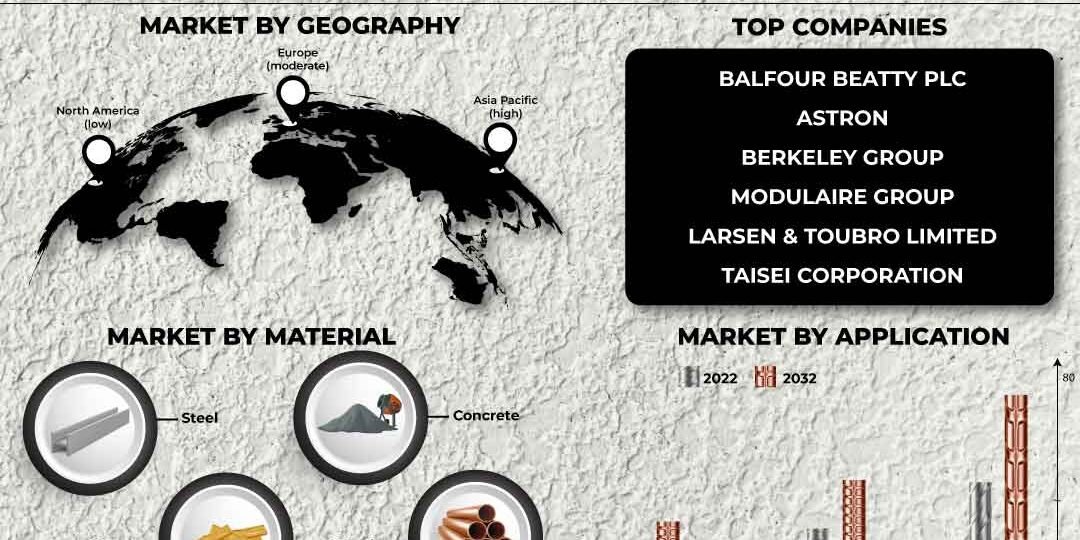
Global Modular Construction Market by Construction (Permanent Modular Construction, Relocatable Modular Construction) Market by Material (Steel, Concrete, Wood, Plastic) Market by Application (Commercial, Industrial/Institutional, Residential) by Geography
MARKET OVERVIEW
The global modular construction market was valued at US$94,678.07 million in 2026. Furthermore, it is projected to reach US$158,823.03 million by 2034. This reflects a CAGR of 6.68% during the forecast period 2026–2034.
Modularization refers to constructing an entire building unit off-site, rather than smaller structural components as in panelization. Consequently, modular units require the least on-site construction time of any method. Plumbing, electrical work, and design finishes are typically installed within the facility itself. Only the assembly of completed units remains once modules reach the site. Moreover, modular buildings are highly versatile and can be designed to serve virtually any function.
They suit hotels, apartments, student housing, and other formats built around repetitive units serving similar purposes. Because construction occurs largely within off-site facilities, conditions stay under tighter control across most of the process. Therefore, prefabrication techniques deliver greater efficiency and quality for large-scale modular commercial construction.

Read our latest blog on the Modular Construction Market
GROWTH ENABLERS
Key growth enablers of the global modular construction market:
- Advantages over traditional construction systems
- Urbanization and industrialization in developing countries
- Labor shortage and workforce constraints
- Lower defects and reworks
- Data center and AI infrastructure buildout
Time and Cost-Effective Method of Construction
Time and cost remain the two defining variables in building activity. Across emerging and developed economies, balancing these dimensions has long shaped industry progress. Modular construction offers one of the clearest resolutions to this tension.
Modular techniques reduce build times by 30% to 50% compared with conventional methods. Since on-site tasks demand fewer workers, the procedure stays cost-effective. Furthermore, off-site technologies shift most production activity away from the construction site. Consequently, slow field sequences give way to faster factory procedures. Less debris is generated as well, an indirect benefit of reduced onsite work.
Data Center Demand as a New Growth Vector
The AI infrastructure cycle has emerged as a powerful demand driver since 2025. Data center owners now face sustained pressure to bring capacity online within compressed windows tied to revenue activation. Traditional site-centric sequences struggle to meet these expectations at scale. As a result, modular and prefabricated delivery has become a dominant execution model for new projects.
Prefabrication now extends well beyond structural components. Power skids, cooling assemblies, electrical rooms, white space modules, and integrated rack systems are assembled and tested off-site. Industry data indicates highly modularized data center projects achieve schedule reductions of 30% to 50%. Therefore, hyperscale developers increasingly treat modular delivery as a procurement default rather than an alternative.
GROWTH RESTRAINTS
Key growth restraining factors of the global modular construction market:
- Higher costs and logistical complexities
- High initial costs for constructing manufacturing facilities
- Lower awareness
- Tariff exposure and material price volatility
Higher Costs and Logistical Complexities
Most modular operations occur off-site, requiring extensive logistics to move prefabricated units to the jobsite. Accordingly, transportation expenses strongly influence project viability. Research shows that conveying modules beyond 150 to 200 miles produces high transportation costs. Besides, vehicle weight regulations apply to module transport as well.
Limited storage space at urban building sites makes staging areas a critical logistical issue. Also, shipping distances require waterproof packaging that must be stripped before assembly begins.
Tariff Exposure & Input Cost Volatility
Material economics have shifted sharply since the original forecast period. Section 232 duties on steel and aluminum were equalized at 25% in 2025, then extended across derivative products including structural components and fasteners. Those duties doubled to 50% in April 2025. A separate 50% copper tariff took effect on August 1, 2025, with refined copper exempted until a January 2027 review.
Construction materials now carry roughly 10% to 15% more tariff exposure than the broader economy, with steel and lumber most affected. Moreover, steel mills and fabricators are operating at full capacity, prompting contractors to evaluate mass timber as a route around bottlenecks. Consequently, manufacturers face margin compression despite strong order books.
KEY MARKET TRENDS
Global Modular Construction Market | Key Market Trends
Building Information Modeling & Digital Twins
BIM improves construction outcomes by connecting people, technology, and processes. Skyscrapers, hospitals, commercial buildings, and residential structures all benefit from this integration. Time and cost fall while efficiency rises.
The discipline has since advanced beyond coordination. Modular delivery introduces distinct complexity, requiring factory cadence, logistics, and site readiness to align under tighter tolerances. Success now depends on dedicated modular integration capability within the general contractor. That role verifies every module’s digital twin against actual site conditions. Subsequently, mismatches surface in software rather than during crane lifts.
AI-Enabled Design, Compliance, and Scheduling
Artificial intelligence has moved from pilot to production across off-site workflows. Automated code compliance systems analyze complex design models in hours rather than weeks. Machine learning algorithms also process thousands of sequencing scenarios simultaneously, identifying optimal timelines that human planners might overlook. Therefore, plan review — historically a modular bottleneck — is compressing.
Robotics in Factory Assembly
Factory automation is reshaping module production economics. ABB targets robotic automation for modular building and prefabrication, including automated material handling and assembly. Construction robotics is valued at US$1.30 billion in 2026 and projected to reach US$11.14 billion by 2040, with adoption driven largely by workforce constraints. Meanwhile, offsite systems such as modular assembly and robotic 3D printing now feature prominently among the industry’s most-watched robotics deployments.
3D Printing & Modular Convergence
3D printing builds three-dimensional objects from digital models using layered plastics or metals. Although applied across several fields, the technology now reaches modular construction. Modular 3DP construction technology (M3DP) combines both methods. This pairing joins modular adaptability with the cost-effectiveness and customization of 3DP homes.
MARKET SEGMENTATION
Market Segmentation – Construction, Material, and Application
Market by Construction
Permanent Modular Construction
The permanent modular construction segment is projected to lead the construction category during the forecast period. PMC uses lean off-site production to prefabricate single or multistory whole-building solutions in deliverable module sections. Those sections then travel to a permanent building site.
Structures may be built from wood, steel, concrete, or plastic within a secure, controlled environment. Modules are created in a factory, positioned onto foundations, and assembled using large industrial tools such as cranes. Properly maintained PMC buildings deliver long service lives. These structures can also be updated, expanded, remodeled, or renovated throughout their existence. Furthermore, rising labor costs in conventional construction continue pushing adoption toward methods requiring less manual work.
Relocatable Modular Construction
Relocatable demand has broadened beyond traditional swing space. Mining sector expansion, defense infrastructure deployments, and climate-driven disaster recovery programs generate relocatable demand outside standard real estate cycles. Consequently, this segment offers demand resilience through downturns that permanent construction cannot match.
Market by Material
Steel
Steel leads material selection in code-constrained and high-rise applications. Fire resistance and compliance with strict building codes drive preference, particularly in high-density cities. Several nations mandate non-combustible structural materials for certain occupancies, lifting steel uptake in permanent modular work. However, tariff exposure now complicates steel-first specification decisions. Barchart
Wood
Timber has emerged as a viable, widespread substitute for conventional materials. Lightweight properties, high durability, and low toxicity explain its frequent use in modular construction. Moreover, the material is readily recyclable and biodegradable by nature.
Traditional wood studs also feature in modular timber buildings. Although most wood modular buildings were once single-story, engineering advances now enable multi-story wood structures. Furthermore, cost-efficiency, weight, and versatility make timber suitable for permanent and relocatable buildings alike. Wood modules reduce energy waste as well. Also, cellular structure retains thermal energy, delivering higher insulation than steel or concrete.
Recent supply dynamics have strengthened the case further. Steel demand from data centers, coupled with tariffs, has pushed contractors toward mass timber as a way around logistical bottlenecks. Subsequently, low-carbon project mandates are accelerating engineered wood specification.
Concrete
Plastic
Market by Application
- Commercial
- Industrial/Institutional
- Residential
- Data Centers & Digital Infrastructure
REGULATORY LANDSCAPE & STANDARDS
Code Harmonization Through ICC/MBI Standards
The 2027 International Codes, including the IBC and IRC, now incorporate provisions designed to streamline approval of modular and off-site construction. Those changes bring in the ICC/MBI 1200 series, specifically Standards 1200, 1205, and 1210. The framework gives jurisdictions a more consistent basis for reviewing off-site components, potentially reducing approval delays. Seven states have adopted the standards so far, with Maine and New Hampshire among the most recent. The series has also been incorporated into federal facility criteria.
Full potential depends on widespread US adoption, and code updates move on state-specific timelines. Nevertheless, incorporation into the 2027 IBC and IRC sets the industry on a path toward consistency.
Federal Policy Attention on Offsite Housing
A March 2026 HUD report, coauthored by the National Institute of Building Sciences and MOD X, examined offsite construction’s role in meeting national housing needs. The study reviews HUD’s historical work in industrialized housing, compares US experience against other countries, and identifies steps to expand offsite delivery. Therefore, policy momentum now accompanies commercial momentum.
State-Level Program Activity
Individual states continue tightening certification pathways. Pennsylvania exempts industrialized homes and commercial buildings certified before June 1, 2026, provided they remain unsold or not yet placed on permanent foundations. Additionally, Delaware adopted the 2024 International Energy Conservation Code and ASHRAE 90.1-2022 for commercial and high-rise residential buildings in April 2026, alongside EV charging and solar-ready appendices.
RECENT INDUSTRY DEVELOPMENTS
Strategic activity has intensified across manufacturers, contractors, and capital markets.
Consolidation and Capacity Expansion
MODUS Structures completed its acquisition of ROC Modular in September 2026, uniting two established Canadian modular businesses. The combined entity operates under the MODUS brand, ranking among Canada’s largest modular construction companies by workforce and manufacturing footprint.
Skanska launched a modular initiative in March 2026 targeting sustainable commercial and healthcare infrastructure across the United States, integrating prefabricated systems to compress timelines and cut material waste. Clayco expanded modular manufacturing capability for industrial and data center projects in February 2026, adding advanced automation and digital construction technologies. Guerdon Modular Buildings introduced a next-generation multifamily housing platform in January 2026, emphasizing faster assembly and energy efficiency. Lendlease also announced investment in modular technologies for large-scale mixed-use and urban infrastructure work in January 2026. OpenPR
Capital Market Access
BOXABL began trading on the Nasdaq, giving public investors exposure to factory-built modular housing. The company applies advanced manufacturing, automation, and AI to standardize home production. Its platform spans single-family homes, multifamily developments, hotels, and mixed-use projects.
Newer entrants are scaling as well. WEST Manufacturing formally launched to scale steel modular housing across high-demand US markets, pairing factory precision with parallel onsite and offsite coordination. The model targets missing-middle and workforce housing, disaster-recovery rebuilds, and urban infill development.
GEOGRAPHICAL STUDY
North America: The United States and Canada
Europe: The United Kingdom, Germany, France, Italy, Spain, Belgium, Poland, and Rest of Europe
Germany operates the largest construction industry in Europe. Moreover, the country’s residential segment is expected to record moderately high growth. Migration inflows continue stimulating demand for new residential construction.
Germany’s modular and prefabricated construction market reached US$23.19 billion in 2025, with growth projected at a 6.4% CAGR through 2035. Strict building codes, energy-efficiency requirements, and persistent skilled labor shortages are encouraging wider use of factory-built modules.
The United Kingdom’s construction sector contributes around 6% to national GDP. Government investment continues supporting the sector through housing, transport, and infrastructure programs. Additionally, large-scale housing and regeneration commitments, alongside schools, hospitals, and prisons, sustain demand for modular construction materials.
Asia-Pacific: China, Japan, India, South Korea, Indonesia, Thailand, Vietnam, Australia & New Zealand, and Rest of Asia-Pacific
Asia-Pacific’s infrastructure and housing investment pipeline creates the largest single regional volume opportunity.
Rest of World: Latin America, the Middle East & Africa
MAJOR PLAYERS
Major players in the global modular construction market:
- Balfour Beatty PLC
- Astron
- Berkeley Group
- Modulaire Group
- Larsen & Toubro Limited
- Taisei Corporation
- Skanska AB
- Bouygues Construction
- Laing O’Rourke
- Lendlease Group
- Daiwa House Industry Co., Ltd.
- Sekisui House, Ltd.
- Clayco
- Kiewit Corporation
- ATCO Ltd.
- Guerdon, LLC
- Red Sea International
- BOXABL Inc.
- MODUS Structures Inc.
Key strategies adopted by some of these companies:
-
Modulaire Group — leadership reset and balance sheet extension
Modulaire appointed Remco Teulings as Group Chief Executive Officer, effective 15 September 2026. He succeeds interim arrangements in place since August 2025, during which Chairman Richard Ingram oversaw the business alongside the Executive Committee. Teulings arrives with more than 30 years of international experience across building materials and construction, most recently leading Building Materials Europe.
The group refinanced in July 2025, extending maturity on €1.9 billion of debt from 2028 to 2031. Margin improved 60 basis points year-on-year in H1 2025, driven primarily by better sales gross margin rates. Meanwhile, management reported strong demand across the Nordics and Southern Europe, with the German pipeline beginning to recover. Defence, energy, infrastructure, and public sector opportunities anchor the forward book.
Modulaire operates across 25 countries with roughly 271,000 modular space and portable storage units, plus 3,400 remote accommodation rooms. Brands include Algeco, Elliott, Advanté, Carter, ProComm, BUKO, Tecnifor, Locabox, Ausco, Portacom, and Algeco Chengdong. The group also served as an official partner for World Engineering Day 2026, its second consecutive year in that role.
Larsen & Toubro — industrial modularisation as a strategic pivot
L&T estimates the global market for modularisation of industrial projects at US$150 billion. Of that, the company expects roughly US$30 billion in addressable opportunity over the next five years. Rising labour costs and skilled worker shortages are pushing project developers away from conventional site construction toward factory-built modules.
The company completed its first major modularisation project for Australia, shipping modules manufactured at its Kattupalli facility in Tamil Nadu to Karratha in Western Australia. Furthermore, L&T has established a dedicated cell focused on small modular construction. Data centres, prefabricated bridges, and precast columns feature among the industrialised construction avenues under exploration.
Domestically, the firm is developing a hybrid approach combining modular and conventional methods to work around transportation constraints. Earlier benchmarks illustrate the productivity case: a seven-storey flight control system integration facility for DRDO was completed in 45 days using integrated hybrid modular technology. Additionally, 96 apartments were delivered in 96 days for CIDCO using precast systems.
Balfour Beatty PLC — offsite integrated into specialist services
Balfour Beatty channels modular capability through Balfour Beatty Kilpatrick, its mechanical, electrical, and offsite solutions arm. That unit delivers modular solutions for complex infrastructure projects through dedicated offsite manufacturing facilities. Its Modular Systems+ site ranks among the largest offsite fabrication facilities in the United Kingdom, producing modular plant rooms, containment, and laboratory bench services.
The group builds modular electrical systems on a just-in-time basis, designing and fabricating each component only when required. Consequently, processing times fall while stock levels and waste stay controlled. Working less at height and reducing live testing risk also strengthen the safety case for offsite delivery.
Berkeley Group — a cautionary read on volumetric economics
Berkeley Modular operates a volumetric housing factory at Northfleet in Kent. The company completed manufacture of its first modules for the urban house at Kidbrooke Village, installing all 96 units on site. However, Berkeley subsequently held back full factory production.
Management cited the exit of other parties from the industry, driven by costs and by the efficiency impact of regulatory and planning uncertainty on stable production pipelines. Its stated focus turned to evolving the product to strip out cost, weight, and complexity, while working with statutory bodies toward the regulatory approvals needed for efficient delivery. Therefore, the case underscores why the 2027 I-Code harmonisation carries commercial weight, not merely administrative significance.
Bouygues Construction — digital partnership with Dassault Systèmes
Bouygues Construction and Dassault Systèmes renewed their strategic partnership in June 2022, targeting new horizons in construction. The three-year renewal was set to accelerate research and development of cloud-based and mobile-enabled modular and systemic approaches. Aims included transforming the industry’s fragmented, multiscale ecosystems while addressing sustainability issues.
REPORT SYNOPSIS
| REPORT SCOPE | DETAILS |
|---|---|
| Market Forecast Years | 2026-2034 |
| Base Year | 2025 |
| Market Historical Years | 2022-2025 |
| Forecast Units | Revenue ($ Billion) |
| Segments Analyzed | Construction, Material, Application |
| Geographies Analyzed | North America, Europe, Asia-Pacific, and Rest of World |
| Companies Analyzed | ACS Actividades de Construccion y Servicios SA, Astron, Balfour Beatty PLC, Berkeley Group (Berkeley Modular), Bouygues Construction, Kleusberg GmbH & Co KG, Guerdon Modular Buildings, Jeff Luchetti Construction Inc, Julius Berger Nigeria PLC, Koma Modular, Laing O’Rourke, Larsen & Toubro Limited, Modulaire Group, Palomar Modular Buildings, Riko Hiše doo, Red Sea Housing, Skanska Group, System House R&C Co Ltd, Taisei Corporation, Wernick Group |
TABLE OF CONTENT
-
RESEARCH SCOPE & METHODOLOGY
- STUDY OBJECTIVES
- METHODOLOGY
- ASSUMPTIONS & LIMITATIONS
-
EXECUTIVE SUMMARY
- MARKET SIZE & ESTIMATES
- MARKET OVERVIEW
- SCOPE OF STUDY
- CRISIS SCENARIO ANALYSIS
- MAJOR MARKET FINDINGS
- MODULAR CONSTRUCTION IS MORE ECONOMICAL THAN OTHER TYPES
- MODULAR CONSTRUCTION INCURS TRANSPORTATION COSTS, FURTHER INFLUENCING THE PROJECT’S FEASIBILITY
- A NEW WAVE OF ATTENTION AND INVESTMENT
-
MARKET DYNAMICS
- KEY DRIVERS
- ADVANTAGES OVER TRADITIONAL CONSTRUCTION SYSTEMS
- URBANIZATION AND INDUSTRIALIZATION IN DEVELOPING COUNTRIES
- TIME AND COST-EFFECTIVE METHOD OF CONSTRUCTION
- LABOR SHORTAGE
- LOWER DEFECTS AND REWORKS
- KEY RESTRAINTS
- HIGHER COSTS AND LOGISTICAL COMPLEXITIES
- HIGH INITIAL COSTS FOR CONSTRUCTING MANUFACTURING FACILITIES
- LOW AWARENESS
- KEY DRIVERS
-
KEY ANALYTICS
- KEY MARKET TRENDS
- PORTER’S FIVE FORCES ANALYSIS
- BUYERS POWER
- SUPPLIERS POWER
- SUBSTITUTION
- NEW ENTRANTS
- INDUSTRY RIVALRY
- GROWTH PROSPECT MAPPING
- GROWTH PROSPECT MAPPING FOR UNITED STATES
- GROWTH PROSPECT MAPPING FOR GERMANY
- GROWTH PROSPECT MAPPING FOR CHINA
- GROWTH PROSPECT MAPPING FOR SAUDI ARABIA
- MARKET MATURITY ANALYSIS
- MARKET CONCENTRATION ANALYSIS
- VALUE CHAIN ANALYSIS
- REGULATORY FRAMEWORK
-
MARKET BY CONSTRUCTION
- PERMANENT MODULAR CONSTRUCTION
- MARKET FORECAST FIGURE
- SEGMENT ANALYSIS
- RELOCATABLE MODULAR CONSTRUCTION
- MARKET FORECAST FIGURE
- SEGMENT ANALYSIS
- PERMANENT MODULAR CONSTRUCTION
-
MARKET BY MATERIAL
- STEEL
- MARKET FORECAST FIGURE
- SEGMENT ANALYSIS
- CONCRETE
- MARKET FORECAST FIGURE
- SEGMENT ANALYSIS
- WOOD
- MARKET FORECAST FIGURE
- SEGMENT ANALYSIS
- PLASTIC
- MARKET FORECAST FIGURE
- SEGMENT ANALYSIS
- STEEL
-
MARKET BY APPLICATION
- COMMERCIAL
- MARKET FORECAST FIGURE
- SEGMENT ANALYSIS
- INDUSTRIAL/INSTITUTIONAL
- MARKET FORECAST FIGURE
- SEGMENT ANALYSIS
- RESIDENTIAL
- MARKET FORECAST FIGURE
- SEGMENT ANALYSIS
- COMMERCIAL
-
GEOGRAPHICAL ANALYSIS
- NORTH AMERICA
- MARKET SIZE & ESTIMATES
- NORTH AMERICA MODULAR CONSTRUCTION MARKET DRIVERS
- NORTH AMERICA MODULAR CONSTRUCTION MARKET CHALLENGES
- KEY PLAYERS IN NORTH AMERICA MODULAR CONSTRUCTION MARKET
- COUNTRY ANALYSIS
- UNITED STATES
- UNITED STATES MODULAR CONSTRUCTION MARKET SIZE & OPPORTUNITIES
- CANADA
- CANADA MODULAR CONSTRUCTION MARKET SIZE & OPPORTUNITIES
- UNITED STATES
- EUROPE
- MARKET SIZE & ESTIMATES
- EUROPE MODULAR CONSTRUCTION MARKET DRIVERS
- EUROPE MODULAR CONSTRUCTION MARKET CHALLENGES
- KEY PLAYERS IN EUROPE MODULAR CONSTRUCTION MARKET
- COUNTRY ANALYSIS
- UNITED KINGDOM
- UNITED KINGDOM MODULAR CONSTRUCTION MARKET SIZE & OPPORTUNITIES
- GERMANY
- GERMANY MODULAR CONSTRUCTION MARKET SIZE & OPPORTUNITIES
- FRANCE
- FRANCE MODULAR CONSTRUCTION MARKET SIZE & OPPORTUNITIES
- ITALY
- ITALY MODULAR CONSTRUCTION MARKET SIZE & OPPORTUNITIES
- SPAIN
- SPAIN MODULAR CONSTRUCTION MARKET SIZE & OPPORTUNITIES
- BELGIUM
- BELGIUM MODULAR CONSTRUCTION MARKET SIZE & OPPORTUNITIES
- POLAND
- POLAND MODULAR CONSTRUCTION MARKET SIZE & OPPORTUNITIES
- REST OF EUROPE
- REST OF EUROPE MODULAR CONSTRUCTION MARKET SIZE & OPPORTUNITIES
- UNITED KINGDOM
- ASIA-PACIFIC
- MARKET SIZE & ESTIMATES
- ASIA-PACIFIC MODULAR CONSTRUCTION MARKET DRIVERS
- ASIA-PACIFIC MODULAR CONSTRUCTION MARKET CHALLENGES
- KEY PLAYERS IN ASIA-PACIFIC MODULAR CONSTRUCTION MARKET
- COUNTRY ANALYSIS
- CHINA
- CHINA MODULAR CONSTRUCTION MARKET SIZE & OPPORTUNITIES
- JAPAN
- JAPAN MODULAR CONSTRUCTION MARKET SIZE & OPPORTUNITIES
- INDIA
- INDIA MODULAR CONSTRUCTION MARKET SIZE & OPPORTUNITIES
- SOUTH KOREA
- SOUTH KOREA MODULAR CONSTRUCTION MARKET SIZE & OPPORTUNITIES
- INDONESIA
- INDONESIA MODULAR CONSTRUCTION MARKET SIZE & OPPORTUNITIES
- THAILAND
- THAILAND MODULAR CONSTRUCTION MARKET SIZE & OPPORTUNITIES
- VIETNAM
- VIETNAM MODULAR CONSTRUCTION MARKET SIZE & OPPORTUNITIES
- AUSTRALIA & NEW ZEALAND
- AUSTRALIA & NEW ZEALAND MODULAR CONSTRUCTION MARKET SIZE & OPPORTUNITIES
- REST OF ASIA-PACIFIC
- REST OF ASIA-PACIFIC MODULAR CONSTRUCTION MARKET SIZE & OPPORTUNITIES
- CHINA
- REST OF WORLD
- MARKET SIZE & ESTIMATES
- REST OF WORLD MODULAR CONSTRUCTION MARKET DRIVERS
- REST OF WORLD MODULAR CONSTRUCTION MARKET CHALLENGES
- KEY PLAYERS IN REST OF WORLD MODULAR CONSTRUCTION MARKET
- REGIONAL ANALYSIS
- LATIN AMERICA
- LATIN AMERICA MODULAR CONSTRUCTION MARKET SIZE & OPPORTUNITIES
- MIDDLE EAST & AFRICA
- MIDDLE EAST & AFRICA MODULAR CONSTRUCTION MARKET SIZE & OPPORTUNITIES
- LATIN AMERICA
- NORTH AMERICA
-
COMPETITIVE LANDSCAPE
- KEY STRATEGIC DEVELOPMENTS
- MERGERS & ACQUISITIONS
- PRODUCT LAUNCHES & DEVELOPMENTS
- PARTNERSHIPS & AGREEMENTS
- BUSINESS EXPANSIONS & DIVESTITURES
- COMPANY PROFILES
- ACS ACTIVIDADES DE CONSTRUCCION Y SERVICIOS SA
- COMPANY OVERVIEW
- SERVICES LIST
- ASTRON
- COMPANY OVERVIEW
- SERVICES LIST
- BALFOUR BEATTY PLC
- COMPANY OVERVIEW
- PRODUCTS LIST
- BERKELEY GROUP (BERKELEY MODULAR)
- COMPANY OVERVIEW
- RECENT DEVELOPMENTS
- BOUYGUES CONSTRUCTION
- COMPANY OVERVIEW
- RECENT DEVELOPMENTS
- GUERDON MODULAR BUILDINGS
- COMPANY OVERVIEW
- RECENT DEVELOPMENTS
- JEFF LUCHETTI CONSTRUCTION INC
- COMPANY OVERVIEW
- RECENT DEVELOPMENTS
- JULIUS BERGER NIGERIA PLC
- COMPANY OVERVIEW
- RECENT DEVELOPMENTS
- KLEUSBERG GMBH & CO KG
- COMPANY OVERVIEW
- PRODUCTS LIST
- KOMA MODULAR
- COMPANY OVERVIEW
- PRODUCTS LIST
- LAING O’ROURKE
- COMPANY OVERVIEW
- RECENT DEVELOPMENTS
- LARSEN & TOUBRO LIMITED
- COMPANY OVERVIEW
- RECENT DEVELOPMENTS
- MODULAIRE GROUP
- COMPANY OVERVIEW
- PRODUCTS LIST
- PALOMAR MODULAR BUILDINGS
- COMPANY OVERVIEW
- RECENT DEVELOPMENTS
- RIKO HIŠE D.O.O.
- COMPANY OVERVIEW
- RECENT DEVELOPMENTS
- RED SEA HOUSING
- COMPANY OVERVIEW
- RECENT DEVELOPMENTS
- SKANSKA GROUP
- COMPANY OVERVIEW
- RECENT DEVELOPMENTS
- SYSTEM HOUSE R&C CO LTD
- COMPANY OVERVIEW
- RECENT DEVELOPMENTS
- TAISEI CORPORATION
- COMPANY OVERVIEW
- RECENT DEVELOPMENTS
- WERNICK GROUP
- COMPANY OVERVIEW
- PRODUCTS LIST
- ACS ACTIVIDADES DE CONSTRUCCION Y SERVICIOS SA
- KEY STRATEGIC DEVELOPMENTS
LIST OF TABLES
TABLE 1: MARKET SNAPSHOT – MODULAR CONSTRUCTION
TABLE 2: GLOBAL MODULAR CONSTRUCTION MARKET, BY CONSTRUCTION, HISTORICAL YEARS, 2018-2022 (IN $ BILLION)
TABLE 3: GLOBAL MODULAR CONSTRUCTION MARKET, BY CONSTRUCTION, FORECAST YEARS, 2023-2032 (IN $ BILLION)
TABLE 4: GLOBAL PERMANENT MODULAR CONSTRUCTION MARKET, BY REGION, HISTORICAL YEARS, 2018-2022 (IN $ BILLION)
TABLE 5: GLOBAL PERMANENT MODULAR CONSTRUCTION MARKET, BY REGION, FORECAST YEARS, 2023-2032 (IN $ BILLION)
TABLE 6: GLOBAL RE-LOCATABLE MODULAR CONSTRUCTION MARKET, BY REGION, HISTORICAL YEARS, 2018-2022 (IN $ BILLION)
TABLE 7: GLOBAL RE-LOCATABLE MODULAR CONSTRUCTION MARKET, BY REGION, FORECAST YEARS, 2023-2032 (IN $ BILLION)
TABLE 8: GLOBAL MODULAR CONSTRUCTION MARKET, BY MATERIAL, HISTORICAL YEARS, 2018-2022 (IN $ BILLION)
TABLE 9: GLOBAL MODULAR CONSTRUCTION MARKET, BY MATERIAL, FORECAST YEARS, 2023-2032 (IN $ BILLION)
TABLE 10: GLOBAL STEEL MARKET, BY REGION, HISTORICAL YEARS, 2018-2022 (IN $ BILLION)
TABLE 11: GLOBAL STEEL MARKET, BY REGION, FORECAST YEARS, 2023-2032 (IN $ BILLION)
TABLE 12: GLOBAL CONCRETE MARKET, BY REGION, HISTORICAL YEARS, 2018-2022 (IN $ BILLION)
TABLE 13: GLOBAL CONCRETE MARKET, BY REGION, FORECAST YEARS, 2023-2032 (IN $ BILLION)
TABLE 14: GLOBAL WOOD MARKET, BY REGION, HISTORICAL YEARS, 2018-2022 (IN $ BILLION)
TABLE 15: GLOBAL WOOD MARKET, BY REGION, FORECAST YEARS, 2023-2032 (IN $ BILLION)
TABLE 16: GLOBAL PLASTIC MARKET, BY REGION, HISTORICAL YEARS, 2018-2022 (IN $ BILLION)
TABLE 17: GLOBAL PLASTIC MARKET, BY REGION, FORECAST YEARS, 2023-2032 (IN $ BILLION)
TABLE 18: GLOBAL MODULAR CONSTRUCTION MARKET, BY APPLICATION, HISTORICAL YEARS, 2018-2022 (IN $ BILLION)
TABLE 19: GLOBAL MODULAR CONSTRUCTION MARKET, BY APPLICATION, FORECAST YEARS, 2023-2032 (IN $ BILLION)
TABLE 20: GLOBAL COMMERCIAL MARKET, BY REGION, HISTORICAL YEARS, 2018-2022 (IN $ BILLION)
TABLE 21: GLOBAL COMMERCIAL MARKET, BY REGION, FORECAST YEARS, 2023-2032 (IN $ BILLION)
TABLE 22: GLOBAL INDUSTRIAL/INSTITUTIONAL MARKET, BY REGION, HISTORICAL YEARS, 2018-2022 (IN $ BILLION)
TABLE 23: GLOBAL INDUSTRIAL/INSTITUTIONAL MARKET, BY REGION, FORECAST YEARS, 2023-2032 (IN $ BILLION)
TABLE 24: GLOBAL RESIDENTIAL MARKET, BY REGION, HISTORICAL YEARS, 2018-2022 (IN $ BILLION)
TABLE 25: GLOBAL RESIDENTIAL MARKET, BY REGION, FORECAST YEARS, 2023-2032 (IN $ BILLION)
TABLE 26: GLOBAL MODULAR CONSTRUCTION MARKET, BY GEOGRAPHY, HISTORICAL YEARS, 2018-2022 (IN $ BILLION)
TABLE 27: GLOBAL MODULAR CONSTRUCTION MARKET, BY GEOGRAPHY, FORECAST YEARS, 2023-2032 (IN $ BILLION)
TABLE 28: NORTH AMERICA MODULAR CONSTRUCTION MARKET, BY COUNTRY, HISTORICAL YEARS, 2018-2022 (IN $ BILLION)
TABLE 29: NORTH AMERICA MODULAR CONSTRUCTION MARKET, BY COUNTRY, FORECAST YEARS, 2023-2032 (IN $ BILLION)
TABLE 30: KEY PLAYERS OPERATING IN NORTH AMERICA MODULAR CONSTRUCTION MARKET
TABLE 31: EUROPE MODULAR CONSTRUCTION MARKET, BY COUNTRY, HISTORICAL YEARS, 2018-2022 (IN $ BILLION)
TABLE 32: EUROPE MODULAR CONSTRUCTION MARKET, BY COUNTRY, FORECAST YEARS, 2023-2032 (IN $ BILLION)
TABLE 33: KEY PLAYERS OPERATING IN EUROPE MODULAR CONSTRUCTION MARKET
TABLE 34: ASIA-PACIFIC MODULAR CONSTRUCTION MARKET, BY COUNTRY, HISTORICAL YEARS, 2018-2022 (IN $ BILLION)
TABLE 35: ASIA-PACIFIC MODULAR CONSTRUCTION MARKET, BY COUNTRY, FORECAST YEARS, 2023-2032 (IN $ BILLION)
TABLE 36: KEY PLAYERS OPERATING IN ASIA-PACIFIC MODULAR CONSTRUCTION MARKET
TABLE 37: REST OF WORLD MODULAR CONSTRUCTION MARKET, BY REGION, HISTORICAL YEARS, 2018-2022 (IN $ BILLION)
TABLE 38: REST OF WORLD MODULAR CONSTRUCTION MARKET, BY REGION, FORECAST YEARS, 2023-2032 (IN $ BILLION)
TABLE 39: KEY PLAYERS OPERATING IN REST OF WORLD MODULAR CONSTRUCTION MARKET
TABLE 40: LIST OF MERGERS & ACQUISITIONS
TABLE 41: LIST OF PRODUCT LAUNCHES & DEVELOPMENTS
TABLE 42: LIST OF PARTNERSHIPS & AGREEMENTS
TABLE 43: LIST OF BUSINESS EXPANSIONS & DIVESTITURES
LIST OF FIGURES
FIGURE 1: KEY MARKET TRENDS
FIGURE 2: PORTER’S FIVE FORCES ANALYSIS
FIGURE 3: GROWTH PROSPECT MAPPING FOR UNITED STATES
FIGURE 4: GROWTH PROSPECT MAPPING FOR GERMANY
FIGURE 5: GROWTH PROSPECT MAPPING FOR CHINA
FIGURE 6: GROWTH PROSPECT MAPPING FOR SAUDI ARABIA
FIGURE 7: MARKET MATURITY ANALYSIS
FIGURE 8: MARKET CONCENTRATION ANALYSIS
FIGURE 9: VALUE CHAIN ANALYSIS
FIGURE 10: GLOBAL MODULAR CONSTRUCTION MARKET, GROWTH POTENTIAL, BY CONSTRUCTION, IN 2022
FIGURE 11: GLOBAL MODULAR CONSTRUCTION MARKET, BY PERMANENT MODULAR CONSTRUCTION, 2023-2032 (IN $ BILLION)
FIGURE 12: GLOBAL MODULAR CONSTRUCTION MARKET, BY RELOCATABLE MODULAR CONSTRUCTION, 2023-2032 (IN $ BILLION)
FIGURE 13: GLOBAL MODULAR CONSTRUCTION MARKET, GROWTH POTENTIAL, BY MATERIAL, IN 2022
FIGURE 14: GLOBAL MODULAR CONSTRUCTION MARKET, BY STEEL, 2023-2032 (IN $ BILLION)
FIGURE 15: GLOBAL MODULAR CONSTRUCTION MARKET, BY CONCRETE, 2023-2032 (IN $ BILLION)
FIGURE 16: GLOBAL MODULAR CONSTRUCTION MARKET, BY WOOD, 2023-2032 (IN $ BILLION)
FIGURE 17: GLOBAL MODULAR CONSTRUCTION MARKET, BY PLASTIC, 2023-2032 (IN $ BILLION)
FIGURE 18: GLOBAL MODULAR CONSTRUCTION MARKET, GROWTH POTENTIAL, BY APPLICATION, IN 2022
FIGURE 19: GLOBAL MODULAR CONSTRUCTION MARKET, BY COMMERCIAL, 2023-2032 (IN $ BILLION)
FIGURE 20: GLOBAL MODULAR CONSTRUCTION MARKET, BY INDUSTRIAL/INSTITUTIONAL, 2023-2032 (IN $ BILLION)
FIGURE 21: GLOBAL MODULAR CONSTRUCTION MARKET, BY RESIDENTIAL, 2023-2032 (IN $ BILLION)
FIGURE 22: NORTH AMERICA MODULAR CONSTRUCTION MARKET, COUNTRY OUTLOOK, 2022 & 2032 (IN %)
FIGURE 23: UNITED STATES MODULAR CONSTRUCTION MARKET, 2023-2032 (IN $ BILLION)
FIGURE 24: CANADA MODULAR CONSTRUCTION MARKET, 2023-2032 (IN $ BILLION)
FIGURE 25: EUROPE MODULAR CONSTRUCTION MARKET, COUNTRY OUTLOOK, 2022 & 2032 (IN %)
FIGURE 26: UNITED KINGDOM MODULAR CONSTRUCTION MARKET, 2023-2032 (IN $ BILLION)
FIGURE 27: GERMANY MODULAR CONSTRUCTION MARKET, 2023-2032 (IN $ BILLION)
FIGURE 28: FRANCE MODULAR CONSTRUCTION MARKET, 2023-2032 (IN $ BILLION)
FIGURE 29: ITALY MODULAR CONSTRUCTION MARKET, 2023-2032 (IN $ BILLION)
FIGURE 30: SPAIN MODULAR CONSTRUCTION MARKET, 2023-2032 (IN $ BILLION)
FIGURE 31: BELGIUM MODULAR CONSTRUCTION MARKET, 2023-2032 (IN $ BILLION)
FIGURE 32: POLAND MODULAR CONSTRUCTION MARKET, 2023-2032 (IN $ BILLION)
FIGURE 33: REST OF EUROPE MODULAR CONSTRUCTION MARKET, 2023-2032 (IN $ BILLION)
FIGURE 34: ASIA-PACIFIC MODULAR CONSTRUCTION MARKET, COUNTRY OUTLOOK, 2022 & 2032 (IN %)
FIGURE 35: CHINA MODULAR CONSTRUCTION MARKET, 2023-2032 (IN $ BILLION)
FIGURE 36: JAPAN MODULAR CONSTRUCTION MARKET, 2023-2032 (IN $ BILLION)
FIGURE 37: INDIA MODULAR CONSTRUCTION MARKET, 2023-2032 (IN $ BILLION)
FIGURE 38: SOUTH KOREA MODULAR CONSTRUCTION MARKET, 2023-2032 (IN $ BILLION)
FIGURE 39: INDONESIA MODULAR CONSTRUCTION MARKET, 2023-2032 (IN $ BILLION)
FIGURE 40: THAILAND MODULAR CONSTRUCTION MARKET, 2023-2032 (IN $ BILLION)
FIGURE 41: VIETNAM MODULAR CONSTRUCTION MARKET, 2023-2032 (IN $ BILLION)
FIGURE 42: AUSTRALIA & NEW ZEALAND MODULAR CONSTRUCTION MARKET, 2023-2032 (IN $ BILLION)
FIGURE 43: REST OF ASIA-PACIFIC MODULAR CONSTRUCTION MARKET, 2023-2032 (IN $ BILLION)
FIGURE 44: REST OF WORLD MODULAR CONSTRUCTION MARKET, REGIONAL OUTLOOK, 2022 & 2032 (IN %)
FIGURE 45: LATIN AMERICA MODULAR CONSTRUCTION MARKET, 2023-2032 (IN $ BILLION)
FIGURE 46: MIDDLE EAST & AFRICA MODULAR CONSTRUCTION MARKET, 2023-2032 (IN $ BILLION)